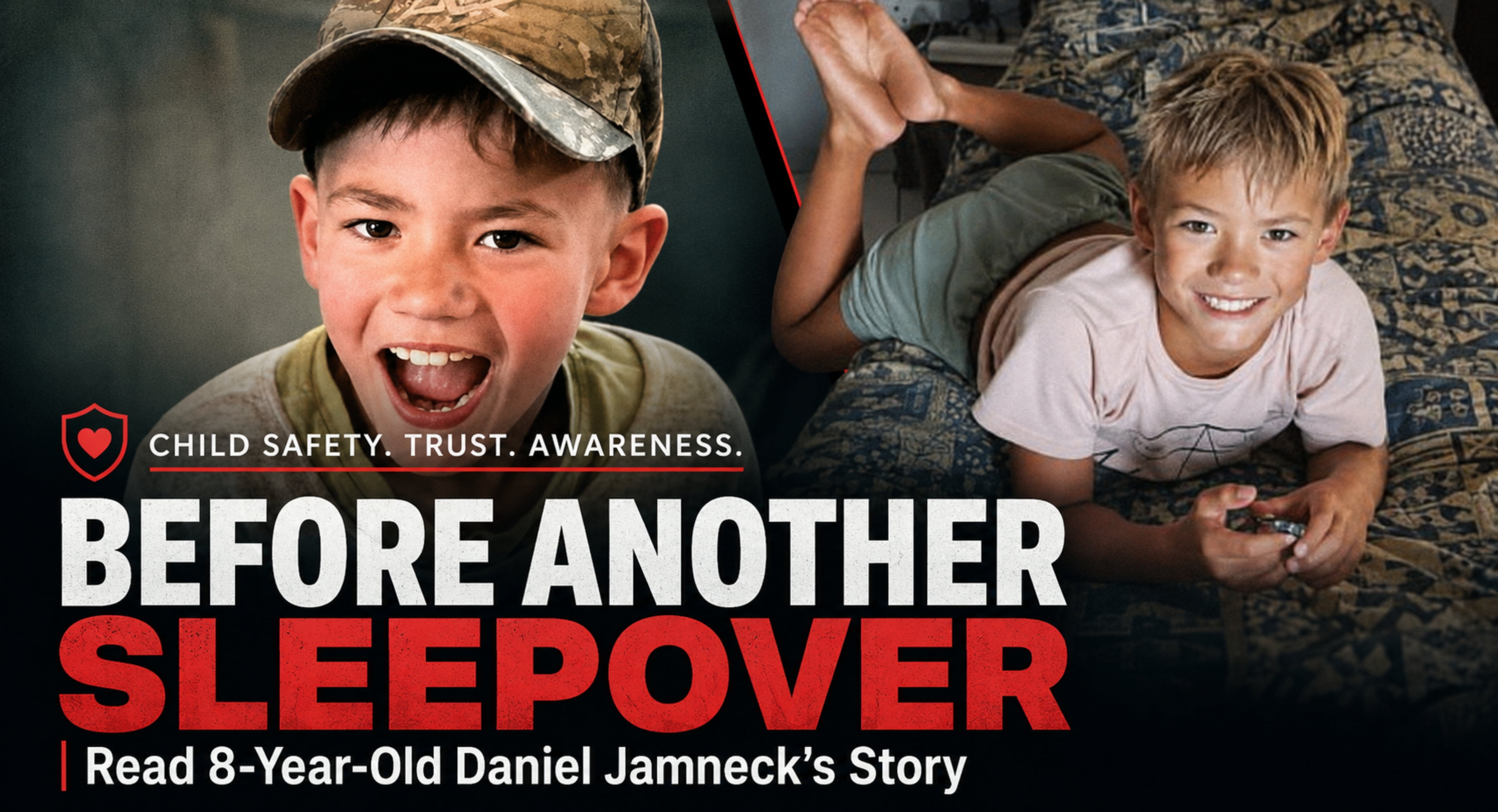





































Eight-
Reader note: This article discusses the rape and murder of a child, without repeating unnecessary graphic details.
SOUTH AFRICA. A sleepover is supposed to be one of childhood’s simplest pleasures.
It is supposed to mean movies watched long after bedtime, whispered conversations between friends, too many sweets, shared blankets and the excitement of waking up somewhere different.
For a parent, allowing a child to sleep at a friend’s home can also feel like a natural step towards independence. The children know each other, the families may have met, the home appears ordinary and the invitation seems harmless.
That was the world in which eight-
On 15 June 2023, Daniël attended a sleepover at his friend’s home in Peerless Park North, Kraaifontein. During that night, he was raped, assaulted and strangled by his friend’s father—a man whose own child was sleeping nearby.
The Western Cape High Court convicted the 49-
The court also sentenced him to ten years’ imprisonment in connection with the 2005 rape of Caryn Brown and eight years for the sexual assault of Daniël, with those sentences ordered to run concurrently with the life term. The court directed that his details be entered into the National Register for Sex Offenders, permanently barred him from working with children and prohibited him from possessing a firearm.
The sentence represents legal accountability.
It does not restore Daniël’s life.
It does not erase what he endured, return him to his mother or give him the future that was stolen from him.
Daniël was more than the crime committed against him
There is a danger when children become the subjects of major criminal cases that the public remembers only the violence.
A photograph is shared. A name becomes a hashtag. Court evidence dominates the discussion, and the child slowly disappears behind the horror of what was done to them.
Daniël must not disappear.
His mother, Maria Jamneck, described him as her “absolute light”. He reportedly loved his younger sister and dreamed of one day becoming a veterinarian. He was a son, a brother, a friend and a little boy with plans that extended far beyond the night on which his life was taken.
No article can fully describe the fear, pain and betrayal he must have experienced inside a home where he had every reason to believe he was safe.
Nor should his suffering be converted into graphic detail for public consumption.
It is enough to understand that an eight-
His dignity must remain greater than the details of his death.
This is not about blaming Daniël’s mother
Nothing in Daniël’s story should be used to blame his mother or suggest that she knowingly placed him in danger.
Parents make decisions using the information available to them.
They cannot see into another person’s mind, uncover every hidden criminal history or predict every act of evil. People who harm children often depend precisely upon appearing ordinary, dependable and trustworthy.
The responsibility for Daniël’s rape and murder rests entirely with the man who committed those crimes.
The purpose of examining sleepover safety is therefore not to stand in judgment of a grieving mother after the fact. It is to ask what families, communities and institutions can learn before another child is placed in another home.
Maria Jamneck has already been forced to live with a pain no parent should ever know. After sentencing, she said that nothing could bring her son back and that the grief would remain with her regardless of the punishment imposed.
Her loss should move the country towards protection—not blame.
The uncomfortable truth about trust
Parents frequently teach children to be cautious of strangers.
But the greater safeguarding challenge is that child sexual abuse is often committed not by an unknown person hiding in the shadows, but by somebody already known to the child or family.
Childline South Africa’s guidance explains that perpetrators are typically known and trusted caregivers, and that abuse frequently depends on manipulation, secrecy and the exploitation of trust rather than obvious violence. Broader child-
That reality changes the questions parents must ask.
The question cannot simply be:
“Does my child know this friend?”
It must also become:
“Do I know the environment in which my child will spend the night?”
Knowing a child from school is not the same as knowing that child’s household.
Meeting a parent briefly at a birthday party is not the same as understanding who lives in the home, who visits regularly, where the children will sleep, what the household’s boundaries are and which adults will have access to them after everyone else has gone to bed.
Trust should not be abandoned.
It should be built carefully.
Why an overnight visit creates different risks
A sleepover places a child in another household for an extended period, often at night, when normal routines have ended and parental oversight is reduced.
The risks are not limited to sexual abuse. Parents may also need to consider older siblings and their friends, alcohol or drug use, unsecured firearms, swimming pools, aggressive animals, unsafe transport, unrestricted internet access, medications, bullying between children and whether adults will remain present and sober.
A house can look safe during a five-
Overnight arrangements also matter. A visiting child should have a clearly identified, age-
Safeguarding advice encourages parents to establish privacy rules, keep play in visible shared spaces where appropriate, avoid unnecessary one-
These are not accusations.
They are reasonable questions about supervision.
A responsible host should understand why another parent is asking them.
Trust must be supported by knowledge
Before allowing an overnight visit, parents should spend time getting to know the entire household—not only the parent who extended the invitation.
That means visiting the home, meeting every adult who lives there, asking whether anyone else will be visiting, understanding the sleeping arrangements and knowing who will supervise the children throughout the evening and morning.
Parents should feel able to ask direct questions:
• Who will be in the home during the sleepover?
• Will any older siblings or their friends be present?
• Where exactly will my child sleep?
• Will an adult share a bed or sleeping area with any of the children?
• Will alcohol or other substances be used by supervising adults?
• Are firearms, medication, internet devices and swimming areas secured?
• Will the children ever be left alone?
• Who will transport them, and where might they go?
• Can my child contact me privately at any time?
• Will you call me immediately if my child becomes uncomfortable or asks to leave?
Child-
Awkwardness should never take priority over a child’s safety.
A parent who becomes angry, evasive or insulted by reasonable safeguarding questions may be providing the answer without realising it.
Children need an unrestricted exit
Children must know that they are allowed to leave a sleepover at any time.
They should never feel that they must remain because their parent has already driven home, because it is late, because they might embarrass their friend or because they cannot explain exactly why they feel uncomfortable.
Parents can establish a simple family rule:
“Call me at any time. You do not have to give me a reason. I will collect you, and you will not be in trouble.”
A private code word can also allow a child to signal distress without explaining the situation in front of other people. A child might send a particular word, emoji or ordinary-
The most important part is that the promise must be real.
A parent who tells a child they can leave at any time must not respond with irritation, embarrassment or questions such as, “Can’t you just stay until the morning?”
Children often struggle to describe why something feels wrong. Their discomfort may appear before they have the language to explain it.
Safety must not depend on a child presenting a complete case.
Body-
Children should be taught, in age-
They should understand that:
• Adults and older children should not ask them to keep secrets about touching, nakedness or photographs.
• Being polite does not mean obeying an instruction that feels unsafe.
• A person can appear friendly and still behave wrongly.
• They will never be blamed for telling a parent what happened.
• They should continue telling trusted adults until somebody listens and acts.
Childline South Africa specifically teaches that people who behave abusively may appear good in other parts of their lives, that abuse rarely stops without intervention and that children should keep telling trusted adults until someone listens.
These conversations should not be framed in a way that terrifies children or makes them believe that every adult is dangerous.
The goal is not fear.
The goal is permission: permission to recognise discomfort, permission to say no, permission to leave and permission to speak.
Listen when behaviour changes
Children do not always disclose abuse directly.
Sometimes they become afraid of a particular person or home. They may suddenly refuse an activity they previously enjoyed, experience nightmares, become withdrawn or unusually angry, regress in behaviour, complain of unexplained pain or display knowledge that appears inappropriate for their age.
None of these signs proves that abuse occurred. Children’s behaviour can change for many reasons.
But a sudden change deserves calm attention.
Parents should ask open, non-
“You seem worried about going there. Can you tell me what is making you uncomfortable?”
They should avoid interrogation, accusation or repeatedly suggesting answers.
When a child does disclose abuse, guidance recommends remaining calm, allowing the child to speak in their own words, believing them, reassuring them that they are not responsible and taking immediate steps to secure their safety. Childline also advises recording what the child said as accurately as possible because the first person told may later be required to explain the disclosure in court.
A child’s first experience of being believed can shape whether they continue speaking or retreat into silence.
The question of a hidden criminal history
Daniël’s case carries another deeply troubling dimension.
The court heard that the man responsible had a history connected to a 2005 rape case and had absconded from a correctional-
South Africa has a National Register for Sex Offenders, but the register is confidential and cannot be searched by members of the public. Its primary function is to prevent registered offenders from being employed in positions involving children and other vulnerable people. Eligible employers and institutions can apply for clearance information, but an ordinary parent cannot search the register before allowing a child to visit a private home.
This does not mean a fully public register would prevent every offence.
No register can identify somebody who has never been reported, prosecuted or convicted. Public access could also create difficult questions involving privacy, rehabilitation, mistaken identity and vigilantism.
But Daniël’s case strengthens the argument for a serious national discussion about whether parents should have some lawful, controlled mechanism to assess known risks when another adult will have prolonged and private access to their child.
A register should never create a false sense of security.
But secrecy should not leave families completely without information either.
Parents are allowed to say no
There is no universal rule requiring parents to permit sleepovers. Some families will allow them only with close relatives or families they have known for years. Others may decide that their children will not sleep away from home at all.
Both decisions are legitimate.
Children can still enjoy friendships through daytime visits, evening “late-
A child may be disappointed.
Another parent may think the rule is excessive.
That discomfort is temporary.
A parent does not owe another family access to their child in order to appear friendly, relaxed or trusting.
A missed sleepover will not destroy a healthy childhood. A failure to act on a genuine concern can change a child’s life forever.
Let Daniël’s name mean something
Daniël Jamneck should not be remembered only as the eight-
He should be remembered as the little boy who loved his sister, wanted to care for animals and trusted that the adults around him would keep him safe.
His mother left court with a sentence, but without her son.
South Africa must therefore do more than briefly grieve, share his photograph and move on when another story begins trending.
Let his name change the questions parents ask.
Let it encourage families to meet properly before children stay over.
Let it make direct conversations about sleeping arrangements, supervision, privacy and household members normal rather than awkward.
Let it remind children that they may call home at any hour and leave any place without first proving that their fear is justified.
Let it remind institutions that known offenders cannot be allowed to disappear through the gaps of an overburdened criminal-
Most importantly, let Daniël be remembered not only for the terror of his final night, but for the childhood and future that should have followed it.
Never forget Daniël Jamneck.
Not because every sleepover will end in danger.
Not because every friend’s parent should be viewed with suspicion. But because trust involving a child must never be casual, unquestioned or unsupported.
When children cannot protect themselves, adults must be willing to ask the difficult questions, establish the uncomfortable boundaries and say no when something does not feel right.
That is not paranoia.
That is protection.