


































More Than Physiotherapy: How Iné Van Deventer Is Helping The Vaal Reclaim Quality of Life.
Raised in the Vaal Triangle, Iné completed her schooling at Hoërskool Driehoek in 2008, where she not only distinguished herself academically, but also served as head girl -
From a young age, she developed a strong passion for both academics and sport. Looking back, it is perhaps no surprise that physiotherapy eventually became the path that connected those two worlds together -
During this time, her base was the Johan Heyns Clinic in Vanderbijlpark, although her work extended across multiple clinics throughout the region. The experience exposed her to a wide variety of patients, conditions, injuries, and recovery journeys, further deepening both her clinical understanding and her connection to the communities of the Vaal. Medicine and healthcare were also not unfamiliar environments to her growing up. Her grandfather previously served as a professor of anaesthetics at the university -
Once her community service year was completed, opportunities presented themselves both within Vaalpark and at Mediclinic Vereeniging, but for her, the decision was about more than simply choosing a workplace.
She knew she wanted to continue building her future in the Vaal -
She did not want her work to exist only within the structure of a hospital environment.
While hospitals play a critical role in treatment and recovery, she found herself increasingly drawn toward working more directly with people in a more personal and ongoing capacity. She wanted the opportunity to remain part of people’s recovery journeys beyond the immediate clinical environment. That decision would ultimately help shape the path she continues walking today -
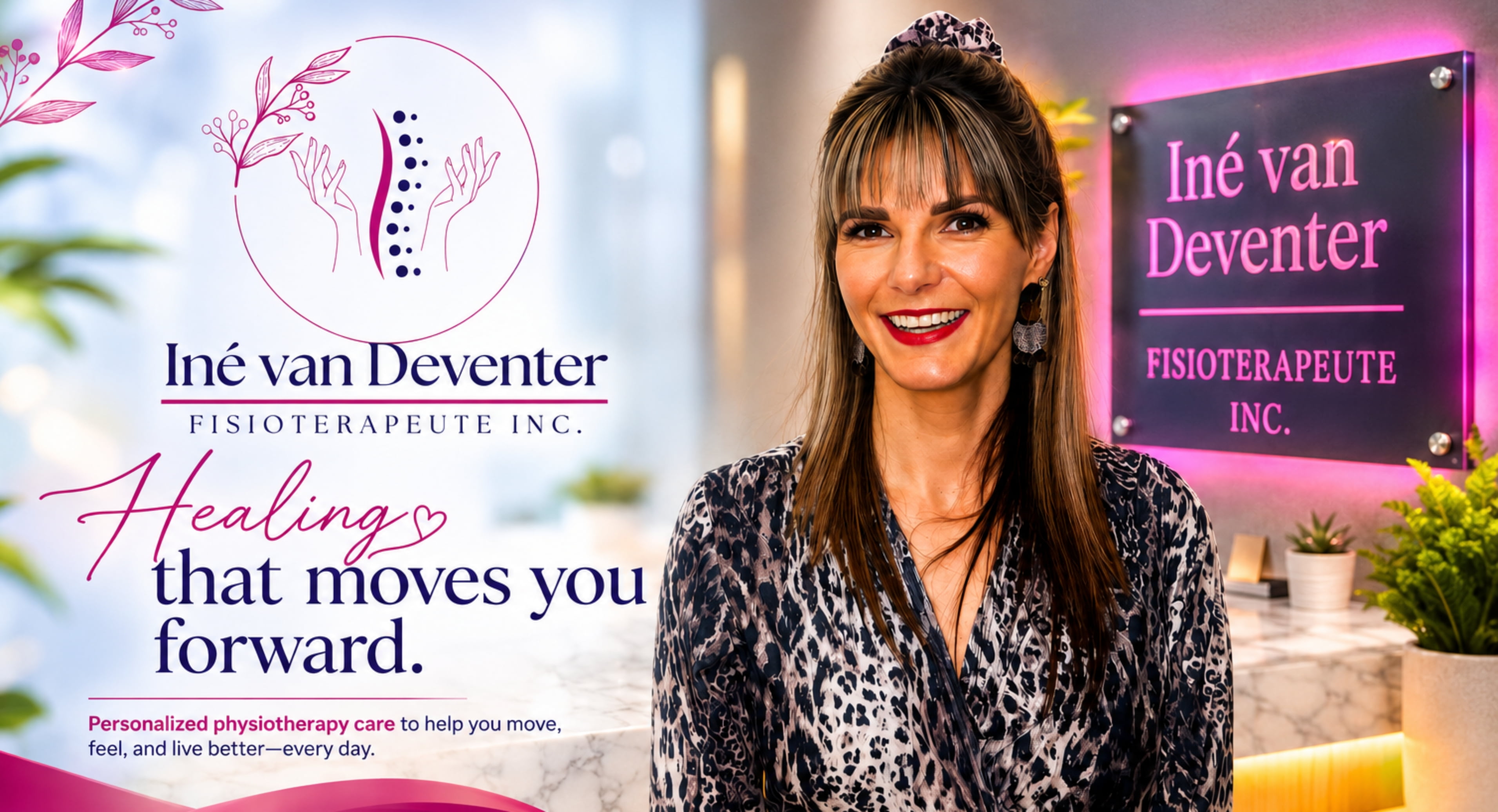
Today, she practices at Iné Van Deventer Fisioterapeute Inc, where she continues helping patients across the Vaal region through personalised physiotherapy and rehabilitation care.
Sport and movement were also never distant concepts in Iné’s life growing up. Throughout her school years, she remained deeply involved in hockey, cross country, and athletics. Looking back, it becomes clear that movement, discipline, and resilience were already deeply woven into who she was long before physiotherapy formally entered the picture. Even today, she believes physiotherapists should actively promote healthy movement and active lifestyles -
But while her love for sport naturally drew her toward physiotherapy, there was another moment in her life that would profoundly shape her decision. One that made the profession suddenly feel real. During her Grade 11 year, her father underwent major heart bypass surgery -
But suddenly, she saw something much bigger.
She saw how rehabilitation and recovery could directly impact a person’s healing journey during one of the most vulnerable moments of their life. And in many ways, that experience became a turning point. What had once been an interest slowly became a calling. It sparked something deeper in her -
From early on in her career, Iné knew that one day she wanted to build a practice of her own.
Not simply to create a business, but to create an environment where she could work more personally with people and make a meaningful difference in their lives. Throughout her years in practice, one reality became increasingly clear to her:
There are far more people living with pain than many realise.
Not always dramatic pain that immediately sends someone to hospital, but the quieter kind that slowly becomes part of everyday life. The back pain people learn to tolerate. The stiff neck that never fully settles. The knee that keeps getting worse. According to Iné, many people unknowingly reach a point where they begin managing pain rather than addressing the underlying causes contributing to it. While pain medication can often help manage symptoms, she explained that many individuals also need to understand the importance of movement, rehabilitation, strengthening, and restoring proper physical function over time.
Because when people stop moving properly due to pain or injury, it often begins affecting far more than only the body itself.
It affects energy levels.
Sleep.
Confidence.
Mood.
Daily function.
And over time, chronic pain can begin impacting emotional wellbeing and mental health in ways many people do not immediately recognise. This is why, for Iné, physiotherapy has always been about something deeper than simply reducing pain.
It is about improving quality of life.
Helping people return to the things they once enjoyed. Helping them regain confidence in their own bodies again. One of the things Iné spoke about most passionately during the conversation was the modern mindset surrounding pain and recovery. According to her, many people today are searching for quick fixes -
“People need to invest in their health and care,” she explained — not only financially, but physically and mentally as well.
And according to her, some of the most common conditions she continues seeing today involve back pain and neck pain -
“The spine was designed to move,” she explained.
Poor ergonomics, prolonged screen time, physical inactivity, and rising stress levels are all contributing significantly to the growing levels of discomfort she sees in modern patients today.
Listening to Iné speak about her profession, one thing became immediately clear. She is deeply passionate about what she does.
Focused. Intentional. Invested.
Not only in treatment itself, but in the long-
Recovery is not always passive.
It often requires patience, consistency, trust in the process, and a willingness to rebuild step by step.
Over time, she explained, she has found that some of the best recovery outcomes often happen once strong relationships are built with patients.
Because once trust develops, patients become more open to understanding:
• the causes contributing to their pain,
• the habits affecting their bodies,
• the importance of movement,
• and the role they themselves play in their long-
A large part of her work today therefore extends beyond treatment itself. It includes education. Helping patients identify harmful habits. Correcting posture and movement patterns. Encouraging healthier lifestyles and greater physical awareness. And perhaps most importantly, helping people emotionally buy into the idea that recovery is possible. One of the strongest themes that emerged throughout the conversation with Iné was the deep connection between physical health, mental wellbeing, and recovery.
For her, the body and mind are never truly separate.
“A healthy mind and a healthy body work together,” she explained.
She also stressed the importance of early intervention after injuries occur. According to Iné, when injuries are addressed early, recovery is often more manageable and rehabilitation can begin before the body starts adapting negatively to pain, stiffness, or restricted movement patterns. However, when injuries are ignored for extended periods of time, the body may gradually begin compensating around the dysfunction itself, often making recovery more difficult over time.
“Go for physio while the injury is still in its early phase,” she explained.
But perhaps the most moving part of the conversation came when Iné reflected on one of the most memorable recovery journeys she has experienced throughout her career. She spoke about a patient who had been involved in a serious motorcycle accident -
According to her, there had been concerns that he might never walk properly again. But slowly, through ongoing rehabilitation, movement, persistence, and consistent physiotherapy, progress began taking place.
Step by step, improvement followed.
Today, the patient is mobile with the assistance of crutches, and his quality of life has improved significantly compared to where his journey began. For Iné, the experience remains one of the most meaningful moments of her career -
If people believe recovery is possible, remain willing to put in the effort, and continue moving forward through the process, meaningful improvement can happen even in extremely difficult circumstances. And for her personally, seeing patients recover and regain parts of their lives again remains one of the greatest blessings of the profession. Throughout the conversation, Iné also spoke about the importance of healthcare professionals working together as part of a larger multi-
While physiotherapy forms an important part of many recovery journeys, she explained that effective patient care often depends on collaboration between various healthcare professionals, each contributing their own expertise within the treatment process.
But beyond treatment itself, one of the strongest messages she hopes to share with the Vaal community is simple:
People need to make time for themselves again.
For their health.
For their movement.
For their wellbeing.
Because according to her, many individuals have slowly accepted pain, discomfort, stiffness, and physical decline as though it is simply something they must live with permanently.
But it does not always have to be that way.
“There is help available,” she explained.
And perhaps most importantly, there is no single approach that fits every patient. Every individual’s body, injury, lifestyle, and recovery journey are different. This is why physiotherapy often involves tailored treatment plans and rehabilitation approaches designed specifically around each person’s unique needs. And the scope of physiotherapy extends far wider than many people realise.
In many ways, physiotherapy is about restoring something people often fear they may never fully get back again -
In addition, physiotherapy also plays an important role in specialised areas of healthcare.
Iné explained that physiotherapists often work with paediatric patients, assisting children with respiratory-
Exercise-
And for those unable to travel easily, she also performs home visits for patients struggling with mobility challenges. Particularly close to her heart, she says, is helping elderly individuals maintain dignity, movement, independence, and quality of life for as long as possible.
Listening to Iné speak, one thing becomes increasingly clear:
For her, physiotherapy is not simply a profession.
It is deeply personal.
It is about helping people move again.
Live again.
Recover again.
And in many ways, the Vaal is fortunate to have healthcare professionals who remain this passionate about improving the lives of the communities they serve every single day.