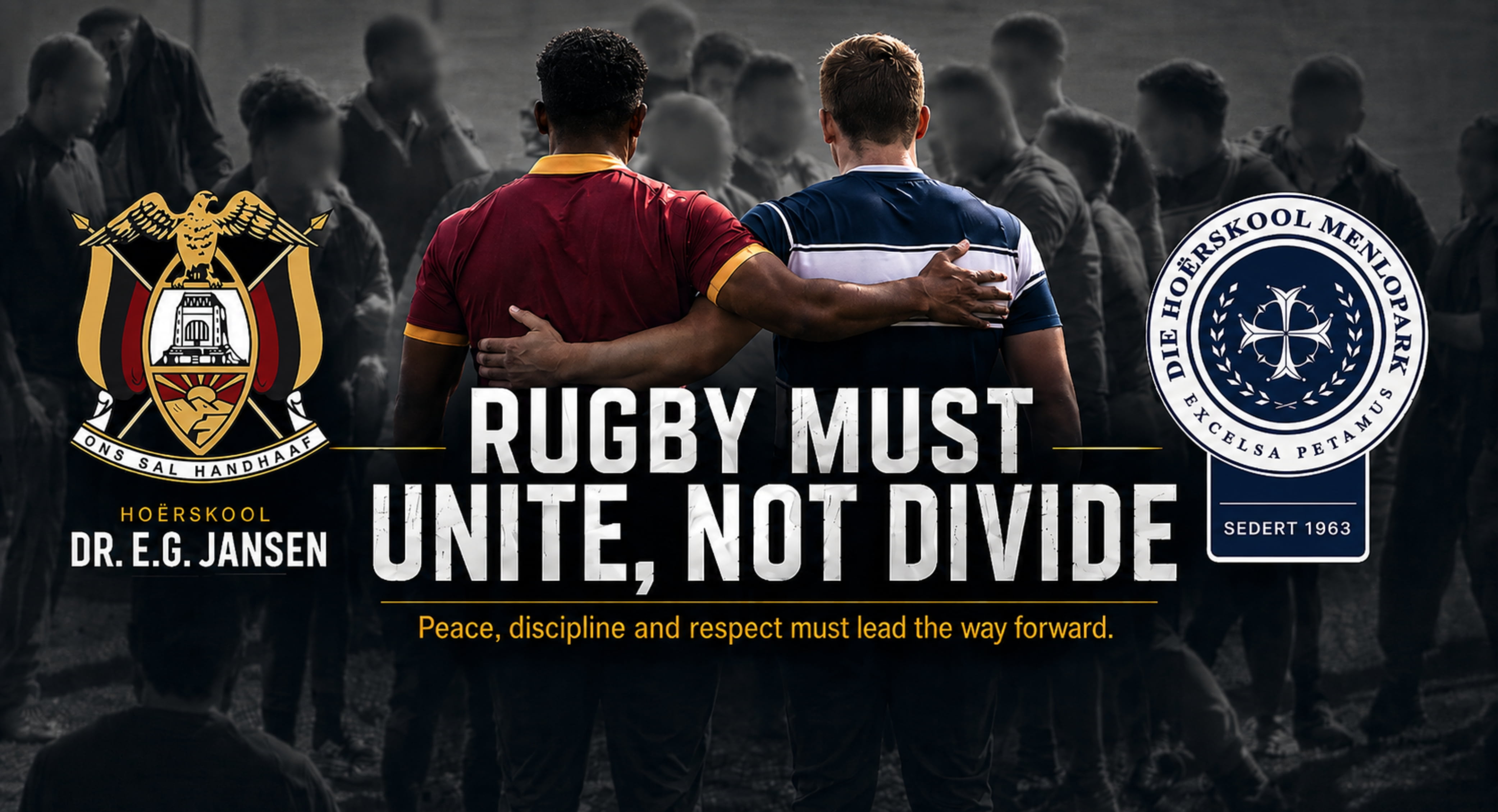





































Dr E.G. Jansen alleges racist abuse and an assault. Menlopark firmly denies the claims. While investigators determine what happened, the public is asking another question: how did a school event governed by safety rules and codes of conduct descend into violence involving learners and adults?
Last updated: Wednesday, 5 August 2026
The fight lasted only minutes. Its consequences may reach much further.
Noordvaal Rugby has placed every player and other person identified as an active participant in the violence on immediate precautionary suspension.
Those affected may not participate in or officially attend any remaining competition matches until the case has been finalised. Both schools must submit reports, witness statements, player statements, videos and other supporting evidence.
Formal disciplinary hearings are expected during the week beginning Monday, 17 August. Noordvaal has stressed that the suspensions are precautionary and do not constitute findings of guilt.
Two schools, two sharply different versions
Hoërskool Dr E.G. Jansen alleges that some of its black and coloured players were racially abused by a group of Menlopark former learners gathered behind the visiting team’s goal line.
The school claims alcohol was consumed and that the alleged abuse included the k-
Dr E.G. Jansen further alleges that concerns were reported to a Menlopark educator before the violence, but that no effective intervention followed. According to the school, the confrontation escalated after one of its players was pulled over a barrier and assaulted.
Menlopark firmly denies the racism allegations.
It says an investigation led by an independent chairperson is at an advanced stage and that evidence considered so far, including statements from neutral match officials, does not support the allegations.
Menlopark also maintains that none of its players, coaches or staff members participated in the violence.
These are opposing accounts, not final findings.
The evidence must now establish what was said, whether concerns were raised, how the physical confrontation began and what role each identified learner or adult played.
The rules were already there
South African schools are not without policies for dealing with violence, discrimination or threatening behaviour.
The Department of Basic Education’s model code of conduct applies to learners at school functions. It requires schools to protect learners, prohibit unfair discrimination and intolerance, and eliminate disruptive or offensive conduct. Learners are expected to behave considerately and may not cause another learner physical or emotional harm.
The National School Safety Framework goes further. It says school personnel must supervise learners, report misconduct, monitor safety procedures and enforce appropriate disciplinary consequences. It also calls for cooperation with law enforcement or private security where necessary.
The framework specifically provides for incidents involving verbal abuse, physical violence, discrimination, alcohol and threats to safety to be formally recorded and addressed.
Menlopark’s own rugby programme identifies respect, diligence, integrity and loyalty as values that should be applied during every practice and match.
The problem, from the public’s perspective, is therefore not that no rules or values existed.
It is that they did not prevent the breakdown witnessed on Saturday.
Whatever the investigation ultimately finds about the alleged comments and first physical contact, match-
Who specifically failed, what warnings were available and whether anyone ignored a complaint remain matters for evidence. But the failure to contain the situation is already visible.
What must now change
The investigation cannot end after identifying who threw punches.
It must establish who was responsible for spectator control, whether adequate security was present and why people were permitted to gather close enough to confront players behind the in-
Future high-
There should also be a controlled exclusion area between players and spectators, an immediate reporting process for racism or threats, and enforceable conduct rules for parents, former learners and other supporters—not only for the children on the field.
School values printed on websites mean little unless they remain enforceable when emotions rise.
What outcome can the public expect?
There is unlikely to be one ruling that decides every part of the matter.
Noordvaal will determine possible sporting sanctions. The schools may conduct separate disciplinary proceedings against their learners. Education authorities may examine whether school policies and safety obligations were properly implemented.
Under the South African Schools Act, school governing bodies may impose sanctions after disciplinary proceedings. However, the expulsion of a learner can be ordered only by the provincial Head of Department after the learner has been found guilty of serious misconduct through a proper process.
Accountability must therefore be firm, but individual and evidence-
Whether this incident brings the two communities together or drives them further apart will depend on what follows.
A transparent investigation, clear findings and visible safety reforms could rebuild confidence. A continuing public-
Unity cannot be created by suppressing difficult allegations. It requires the truth to be tested fairly and proven wrongdoing to be acknowledged.
“These things happen—people must get over it”
Yes, fights happen.
That is precisely why rules, educators, safety plans, barriers and adult supervision exist.
The fact that something happens does not make it harmless or acceptable. Telling people simply to “get over it” risks normalising violence and teaching children that standards matter only until emotions become intense.
That does not mean every allegation must immediately be accepted as fact, or that every learner, parent and employee associated with either school should be blamed.
The responsible position lies between hysteria and indifference: establish the truth, punish proven misconduct, protect the learners and correct the failures that allowed the situation to escalate.
The real test is no longer which school wins the public argument.
It is whether the adults responsible for school rugby can demonstrate the discipline, restraint and leadership that the sport expects from its children.