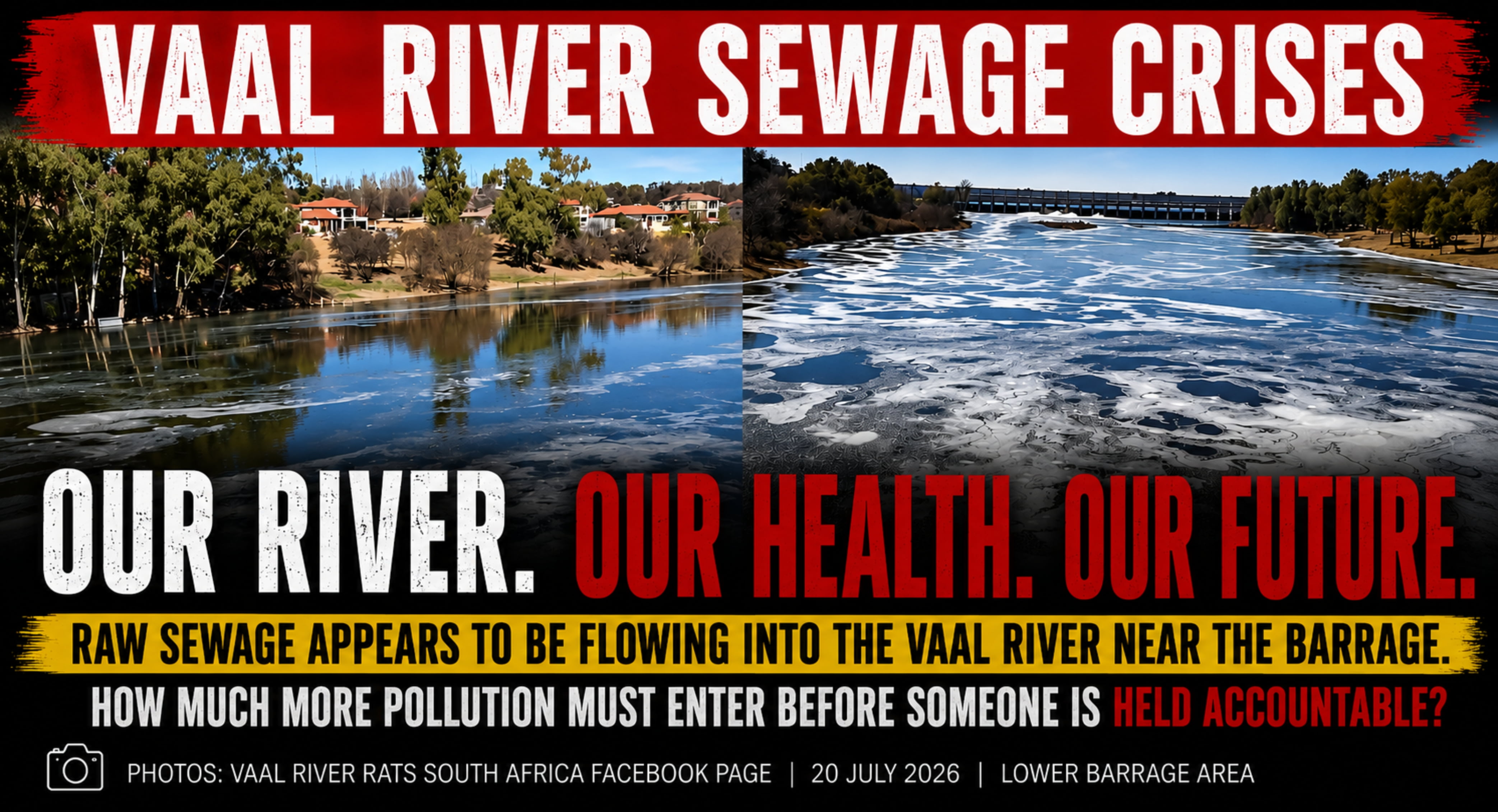





































Fresh concerns over apparent sewage pollution raise urgent questions about public health, the environment and accountability for one of South Africa's most important water resources.
VAAL TRIANGLE. There are few natural resources more important to South Africa than the Vaal River.
It is far more than a river flowing through the Vaal Triangle.
It is one of the country's most strategic water resources, supporting millions of people, supplying homes and businesses, sustaining industry, irrigating farmland, driving tourism and providing countless South Africans with opportunities to fish, boat, relax and enjoy the outdoors.
Without the Vaal River, life across large parts of Gauteng, the Vaal Triangle and surrounding regions would look very different.
That is why the latest images and videos shared by Vaal River Rats South Africa have once again captured the attention of concerned residents.
The Vaal River community group has shared photographs and videos that appear to show untreated sewage flowing into the Vaal River near the Vaal Barrage, renewing longstanding concerns about pollution affecting one of South Africa's most important river systems.
For many residents, these scenes have become painfully familiar.
Perhaps that is the greatest tragedy of all.
South Africans are slowly becoming accustomed to seeing apparent sewage pollution in a river that should be regarded as one of our greatest national assets.
We should never become comfortable with that.
This is not someone else's problem
Many people see sewage entering a river and assume it is simply an environmental issue affecting those who live nearby.
It is not.
The Vaal River affects every person who depends on it, whether they realise it or not.
The river forms part of one of South Africa's most important water supply systems. Raw water from the Vaal River undergoes extensive treatment before being distributed to homes, hospitals, schools, businesses and industries. Those treatment processes are designed to produce drinking water that complies with strict national safety standards.
However, every litre of untreated sewage entering the river increases the burden placed on that treatment process.
It places additional pressure on ageing infrastructure.
It increases operational costs.
It contributes to the long-
The consequences extend far beyond the riverbanks.
They affect municipalities responsible for water treatment.
They affect businesses that rely on clean and reliable water supplies.
They affect farmers, tourism operators, anglers, boating communities and families who have enjoyed the Vaal River for generations.
Ultimately, they affect every taxpayer and every South African who depends on secure, sustainable water resources.
This is not simply about polluted water.
It is about protecting a resource that millions of South Africans rely on every single day.
The impact reaches further than many people realise. Untreated sewage can contain harmful bacteria, viruses, parasites, nutrients and other contaminants.
When these pollutants enter rivers, they can reduce oxygen levels, contribute to fish deaths, encourage harmful algae growth and damage fragile aquatic ecosystems.
The environmental consequences are significant.
But so are the social and economic consequences.
Families lose confidence in places where they once swam, fished and spent weekends together.
Businesses built around tourism and recreation can suffer.
Property values may be affected.
Communities begin to question the long-
As pollution increases, so too does the pressure on water treatment infrastructure, environmental management and public finances.
This is not a problem that simply washes away downstream.
It grows.
The latest reports do not exist in isolation. For years, residents, environmental organisations and community groups have raised concerns about pollution affecting the Vaal River.
Among the most active has been Vaal River Rats South Africa, whose members have repeatedly documented pollution, invasive plants, illegal dumping and environmental degradation while encouraging greater public awareness and meaningful intervention.
Their latest photographs and videos have once again placed the spotlight on a problem that many believe has continued for far too long.
Whether the apparent discharge shown in the recent images is confirmed through official investigations or not, the material raises legitimate public-
Where is the accountability?
If apparent sewage pollution is continuing to affect one of South Africa's most important river systems, then the conversation extends beyond the latest photographs.
It becomes a question of accountability.
Who is monitoring these discharge points?
How quickly are pollution incidents investigated?
What corrective action is taken when problems are identified?
Are existing wastewater treatment systems coping with current demand?
How is water quality being monitored?
How will communities know when meaningful improvements have been made?
These are not political questions.
They are public-
These are the questions any concerned South African has the right to ask when a river of such national importance appears to face repeated pollution concerns.
Accountability is not about assigning blame before the facts are known.
It is about ensuring that concerns are investigated, findings are communicated openly and, where problems are identified, effective corrective action follows.
That is how public trust is built.
That is how confidence is restored.
We cannot afford to look away. Communities have an important role to play by reporting pollution, supporting conservation efforts and demanding transparency.
Those responsible for managing, regulating and protecting South Africa's water resources have an equally important responsibility to investigate concerns, communicate openly and act where intervention is required.
Every generation inherits the country's rivers.
Every generation also decides what it leaves behind.
If we continue accepting reports of apparent sewage pollution in the Vaal River as "just another story", we risk allowing the unacceptable to become normal.
South Africa deserves better. The Vaal deserves better.
Most importantly, the millions of people whose lives are directly and indirectly connected to this river deserve confidence that one of the nation's most valuable natural resources is being protected with the urgency, transparency and commitment it demands.
The Vaal River belongs to all of us.
Protecting it is not only an environmental responsibility.
It is a responsibility to every family that depends on clean water today—and to every generation that will depend on it tomorrow.
Editorial Note: This article draws on recent photographs and videos publicly shared by Vaal River Rats South Africa, together with longstanding and widely documented concerns about sewage pollution affecting the Vaal River system. The material raises serious and legitimate public-
While the precise source, scale and legal responsibility for the discharge shown in the latest material must be established through official investigation and water-